

Custom CRM
Your customer relationships should not depend on workarounds.
Generic CRMs work until your process becomes the advantage. Then every exception moves into spreadsheets, inboxes, and people's memory while the official system falls further behind.
The spreadsheet is not the problem.
It is the signal. Teams create side systems when the CRM does not reflect how they qualify opportunities, coordinate relationships, prepare proposals, hand off work, or decide what should happen next.
Five lost hours a week can cost a 20-person team $312,000 a year.
Searching for context, copying updates, cleaning records, preparing reports, and chasing follow-ups add up. At a $60 loaded hourly cost, five hours per person each week across a 20-person team becomes $312,000 in annual operating time.
A custom CRM with Axiacore usually starts around $50,000 and can reach $150,000, depending on workflow depth, data migration, integrations, and automation.
Lost time per person
2 hrs/week
$124,800 in annual team time.
Lost time per person
5 hrs/week
$312,000 in annual team time.
Lost time per person
8 hrs/week
$499,200 in annual team time.
When does it pay back?
| Team size | $50K build | $100K build | $150K build |
|---|---|---|---|
| 10 people | 1.6 hrs/week | 3.2 hrs/week | 4.8 hrs/week |
| 20 people | 0.8 hrs/week | 1.6 hrs/week | 2.4 hrs/week |
| 40 people | 0.4 hrs/week | 0.8 hrs/week | 1.2 hrs/week |
Break-even shows the weekly time saved per person needed to recover the build investment in one year, using a $60 loaded hourly cost. Hosting, support, licenses, adoption, and the value of improved conversion should be modeled separately.
More than a cleaner pipeline.
Model the real relationship
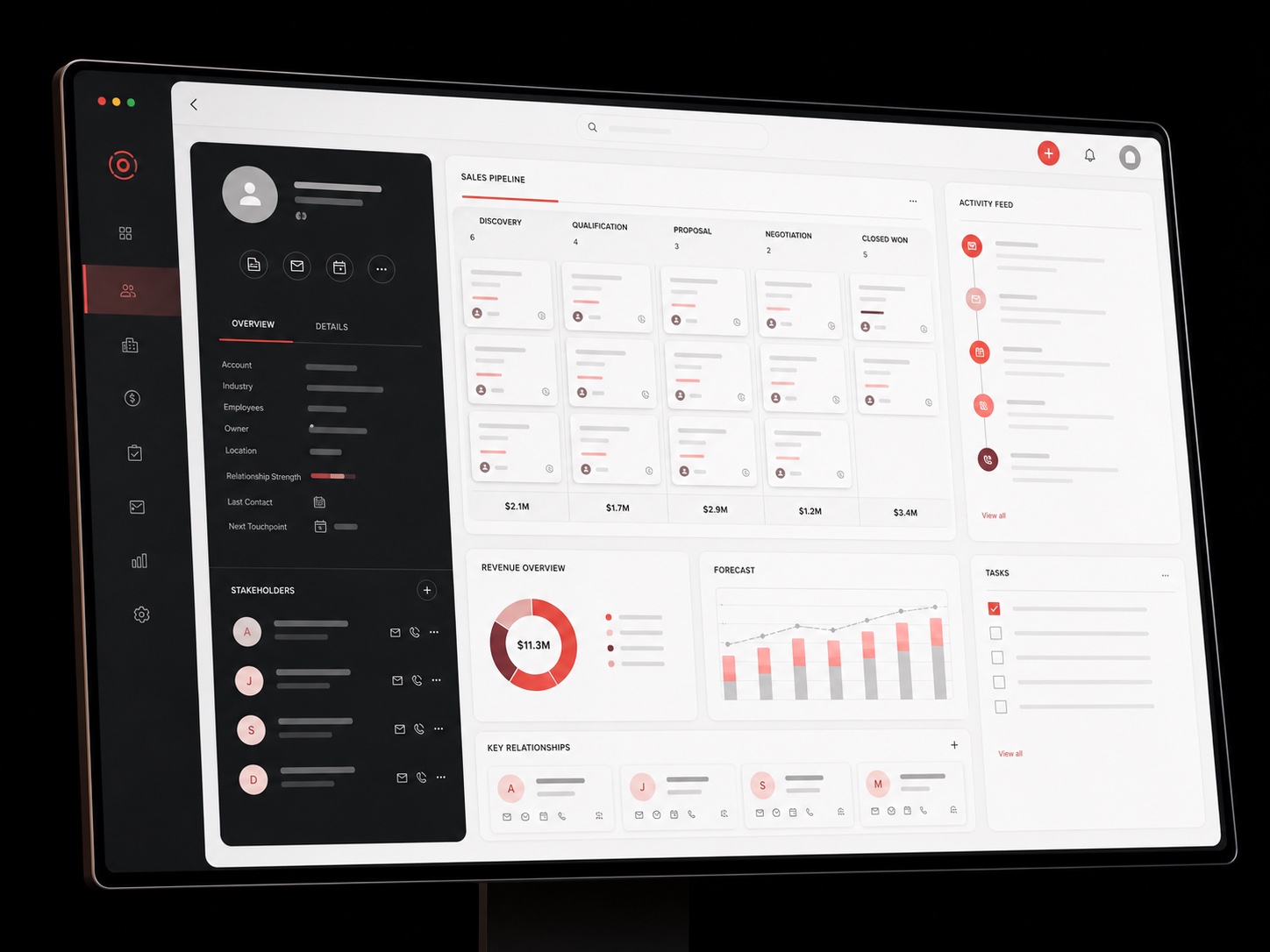
Connect organizations, people, locations, partners, opportunities, contracts, and every stakeholder who affects the decision.
Make the next action obvious
Turn stages, activity, risk, ownership, and deadlines into focused work instead of another dashboard people have to interpret.
Automate the administrative work
Capture updates, create tasks, route approvals, generate documents, and trigger handoffs without asking the team to copy the same information twice.
Measure how revenue actually moves
See conversion, velocity, relationship coverage, source quality, forecast confidence, retention, and the operational reasons behind every result.
Our vision for CRM and AI
The CRM should prepare the work, not wait to be updated after it happens.
AI can turn a CRM from a passive database into an active operating system that understands context, protects follow-through, and helps each person focus on the relationship.
Level 1
Capture the record
Summarize meetings, emails, notes, and calls so the team stops spending time on manual updates.
Level 2
Protect follow-through
Identify missing owners, stale opportunities, unanswered questions, relationship gaps, and commitments at risk.
Level 3
Prepare the next step
Draft follow-ups, briefing notes, proposals, account plans, and meeting agendas using the full customer context.
Level 4
Guide the decision
Recommend priorities, flag risk, compare patterns, and explain why an opportunity needs attention now.
Level 5
Coordinate the workflow
Execute approved routine actions across sales, service, finance, and operations while keeping people in control.
Useful AI depends on useful context. If customer history is fragmented across inboxes, documents, and tools, the system can generate words but cannot reliably understand the relationship.
A custom CRM creates the foundation for relationship-aware AI: structured data, permissions, business rules, process history, integration points, and clear boundaries for what the system can do.
Connected to the work around it.
Email and calendars
Connect conversations, meetings, reminders, relationship history, and follow-up without duplicating work.
Marketing and lead sources
Capture forms, campaigns, events, referrals, qualification data, consent, and attribution in one flow.
Proposals and contracts
Generate documents, coordinate reviews, track approvals, collect signatures, and preserve the context behind every commitment.
Finance and operations
Connect estimates, invoices, payments, onboarding, delivery status, renewals, and account health.
Business intelligence
Give leadership consistent definitions for pipeline, revenue, retention, performance, and forecast risk.
Customer portals and service
Extend the same relationship record into onboarding, support, requests, shared plans, and self-service.
Your CRM should encode how your company earns trust.
We design and build custom CRM systems for companies with complex sales, account management, service, or partnership workflows that generic tools cannot represent cleanly.
The goal is not more data entry. It is a shared system that keeps context intact, makes work visible, improves decisions, and gives every customer a more consistent experience.
Talk to Axiacore